I used to think boundaries were for “stronger” people.
You know the type—confident, quick to say no, never second-guessing themselves. Meanwhile, I’d be over here saying “sure!” with a smile… and then feeling my mood drop an hour later because I just didn’t actually have it in me.
If that sounds familiar, nothing is wrong with you. You are just used to pushing past your own limits.
Mindful boundaries aren’t about being strict or unfriendly. They’re about noticing what’s happening in you before you agree, explain, fix, or carry something that isn’t yours.
And honestly? A boundary can be as small as a simple pause.
What “Mindful Boundaries” Really Means
To me, mindful boundaries are just this:
You pay attention to your capacity… and you act as if it matters.
Not your “best day” capacity. Not the version of you who slept eight hours, drank water, and woke up motivated. Your real capacity—today.
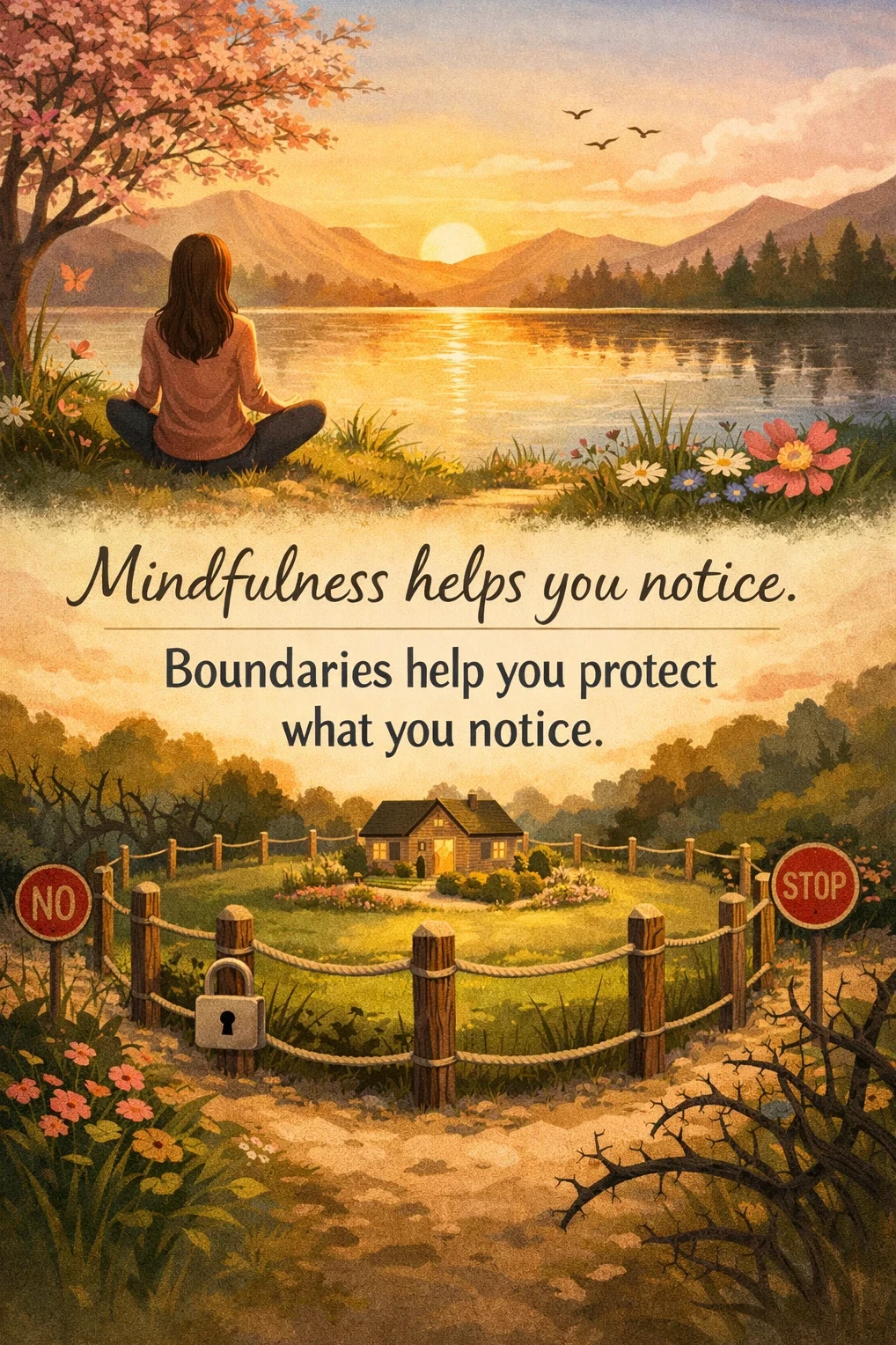
Mindfulness helps you notice.
Boundaries help you protect what you notice.
That’s it.
Top Mindful Boundary Practices That Work in Real Life
1) The Two-Second Pause (Before You Answer Anything)
This is the easiest one to start with, and it’s also the one that saves you the most.
Because most boundary issues happen fast:
- someone asks
- you feel pressured
- you answer quickly
- you regret it later
Try this instead:
Pause. Breathe once. Then decide.
If you need words, keep it simple:
- “Let me check my schedule and get back to you.”
- “I need a minute to think about that.”
You don’t owe an instant yes.
2) Listen to the “Inner Flinch”
You know that tiny reaction you get sometimes?
That little oh no feeling?
Pay attention to it.
For me, it shows up like:
- my shoulders tighten
- my stomach sinks
- I suddenly feel irritated… even though nothing “wrong” happened
That’s your body giving you a message: this might cost you more than you want to spend.
A quick check:
- Do I feel open right now?
- Or do I feel cornered?
If it feels like a corner, slow down.
3) Stop Treating “No” Like a Full Presentation
A lot of us don’t struggle with boundaries because we don’t know what we want.
We struggle because we think we must prove we deserve it.
You don’t.
Pick one sentence and let it stand:
- “I can’t do that.”
- “I’m not available for that.”
- “I’m at capacity this week.”
And then… this part matters… stop adding extra paragraphs.
(Yes, it’s uncomfortable at first. But it gets easier.)
4) Use a “Kind No” Script You Can Repeat Without Thinking
When you’re tired, you don’t need creativity. You need a script.
Here are a few that feel human and not robotic:
- “I can’t take that on right now.”
- “I’m not able to do that, but I hope it works out.”
- “I’m keeping my schedule light this week.”
- “Not this time.”
- “I’m going to pass, but thank you.”
If you want, you can add warmth. You just don’t need to add a debate.
5) Protect Your Mornings (Because They Set the Tone)
If you wake up and immediately start responding to messages, problems, and other people’s energy… your whole day can start feeling off.
A mindful boundary practice that sounds small but hits big:
- no phone for the first 15–30 minutes
- drink water, breathe, pray, stretch, sit in silence—anything that feels like yours
You’re basically telling your brain, “I belong to me first.”
6) Create “Office Hours” for Your Life
This one changed things for me because it stopped the constant feeling of being “on.”
Pick a window:
- respond to texts between 12–1 and 6–7
- check email twice a day
- keep evenings for family or rest
And if someone expects immediate replies? Let them be disappointed. Seriously.
A boundary isn’t real if it collapses every time someone pushes it.
7) Ask: “If I Say Yes… What Am I Saying No To?”
This question is so simple it almost feels annoying.
But it’s honest.
Because a yes isn’t free. It always costs something:
- time
- energy
- focus
- peace
- rest
So ask yourself:
What am I trading away if I agree to this?
Sometimes the answer is: I’m trading my sanity.
That’s your cue.
8) Decide Your Non-Negotiables (Even If They’re Small)
You don’t need a long list. Start with one or two.
Examples:
- I don’t do heavy conversations after 9 PM.
- I don’t agree to last-minute plans unless I genuinely want to.
- I don’t keep explaining myself to someone committed to misunderstanding me.
- I don’t answer calls when I’m overstimulated.
Write yours down.
It’s easier to keep a boundary when you’ve already decided it’s a rule.
9) Practice Boundaries With Yourself (This Is Where It Gets Real)
This is the part I had to learn the hard way:
If I don’t keep promises to myself, it’s harder to keep boundaries with others.
Self-boundaries might look like:
- “I’m going to bed when I say I’m going to bed.”
- “I’m not scrolling in the car before I walk into the house.”
- “I’m taking my lunch break.”
- “I’m not filling every quiet moment with noise.”
No one claps for these. But they build self-trust. And self-trust makes boundaries easier.
10) Let People Have Their Reactions
This one is hard. Let me say it plainly:
Someone being unhappy with your boundary does not mean your boundary is wrong.
Some people benefited from your lack of limits.
So yes—when you change, they might complain.
Your job isn’t to keep everyone comfortable.
Your job is to stay honest.
If your boundary is respectful, let it stand—even if the other person has feelings about it.
Quick Signs You Need a Boundary (Like… Soon)
If you’re wondering whether you “really” need boundaries, check this list:
- you keep agreeing and then feeling irritated later
- you feel tired before the day even starts
- you avoid checking messages because it feels like more demands
- you keep thinking, “Why is everything on me?”
- you feel guilty for resting
That’s not laziness. That’s overload.
Helpful Resources
- Read Choosing Progress Over Perfection — this pairs well because boundaries are basically progress in real time.
- Read my post 10 Mindset Shifts for Freedom & Rest — this supports the “rest isn’t earned” mindset.
- Read 10 Morning Habits to Boost Your Motivation — for those who want a calmer start to the day.
- External resource: Search “nervous system regulation boundary setting” for simple visuals that explain why boundaries feel emotional.
- If you want practical, gentle scripts for saying “no” without guilt, Set Boundaries, Find Peace by Nedra Glover Tawwab is a strong pick.
- For a straightforward, step-by-step guide to setting limits at work, with family, and in relationships, The Book of Boundaries by Melissa Urban is a great resource.
Final Thoughts
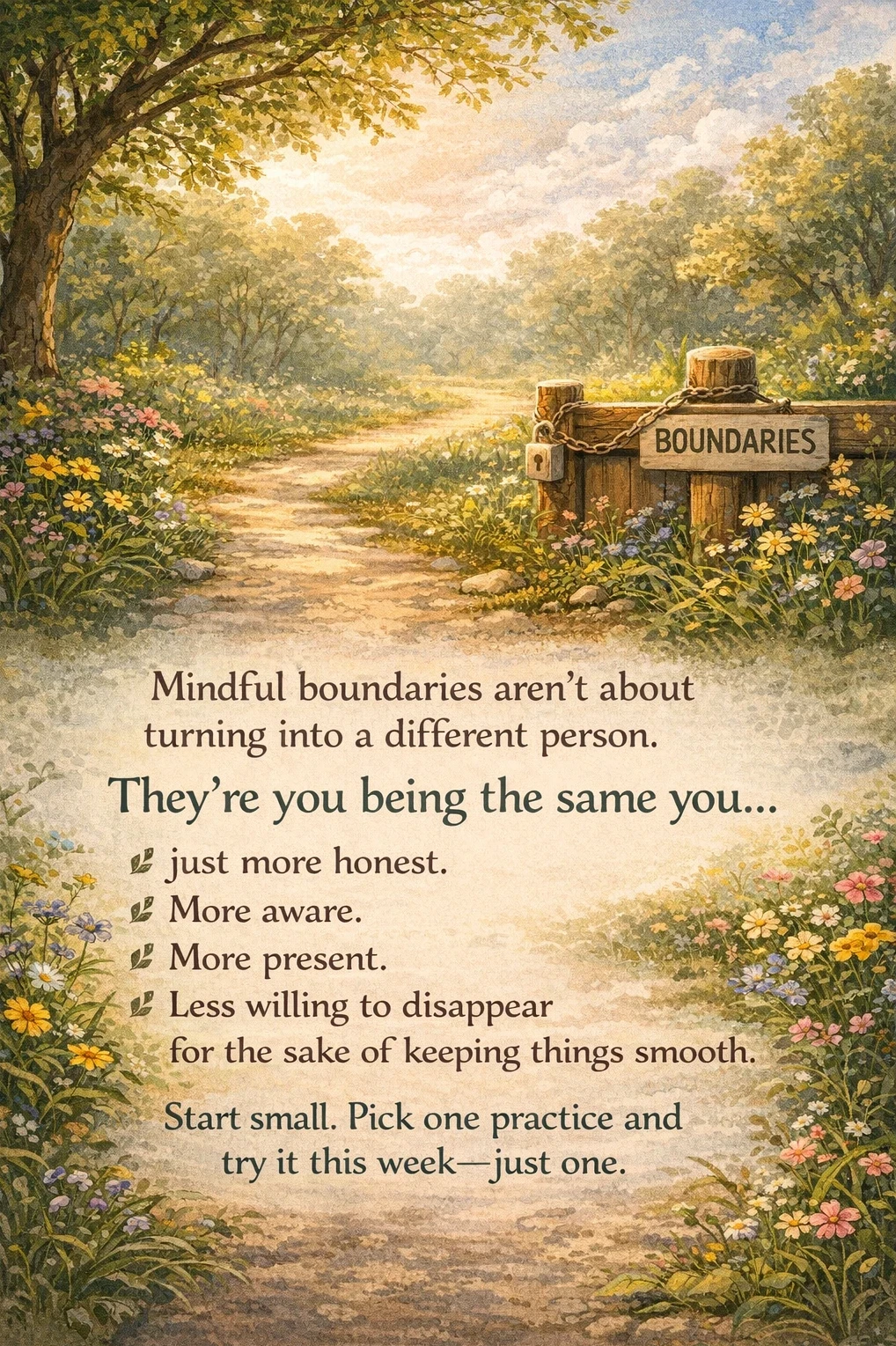
Mindful boundaries aren’t about turning into a different person.
They’re you being the same you… just more honest.
More aware.
More present.
Less willing to disappear for the sake of keeping things smooth.
Start small. Pick one practice and try it this week—just one.
And when it feels awkward (because it will at first), remind yourself: you’re not doing something wrong. You’re doing something new.
Keep shining—your light makes a difference.
~Kay~