Techniques that Actually Fit Real Life
Some days don’t feel “busy.” They feel like a sprint with ankle weights on.
You wake up already behind, your brain opens about 25 tabs before you’ve even brushed your teeth, and by midday you’re doing that thing where you answer an email while reheating your coffee… again. If that’s you, this post is for you.
Mindfulness doesn’t require silence, incense, or a 30-minute meditation cushion. It can be a small, steady habit you weave into the day you already have—no matter how chaotic it is.
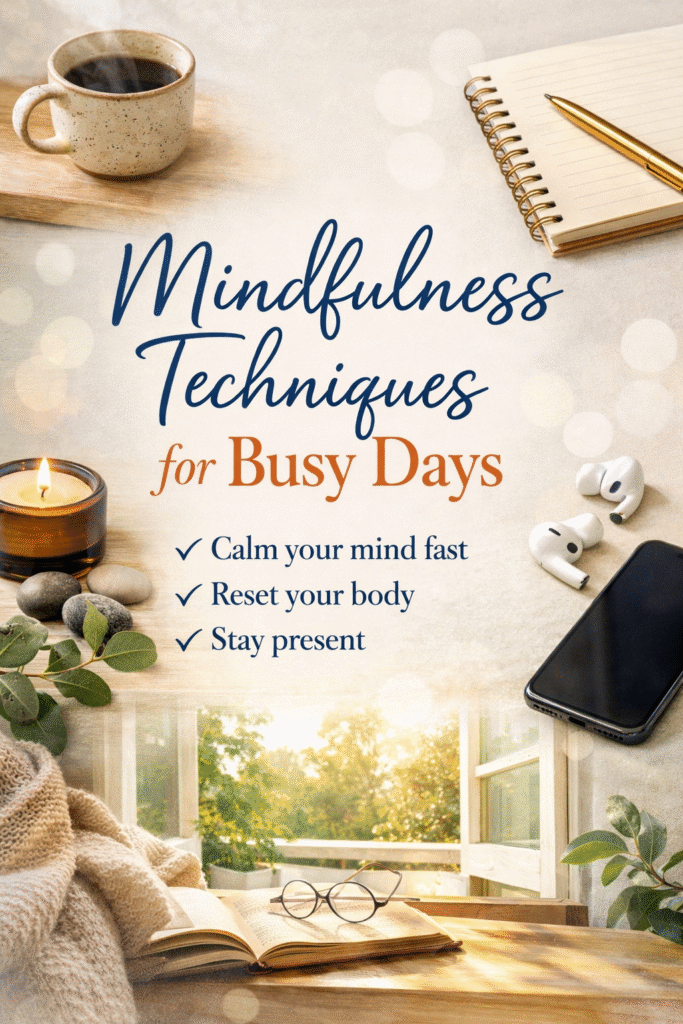
Below are practical mindfulness techniques for busy days—ones you can do in under a minute, at your desk, in the carpool line, or while you’re folding laundry.
What Mindfulness Really Means (In Regular People Words)
Mindfulness is simply noticing what’s happening right now—without judging it.
Not fixing it. Not analyzing it. Not adding a whole storyline to it.
Just noticing.
That could look like:
- Feeling your shoulders tighten while you’re reading a stressful message
- Noticing you’re holding your breath while rushing
- Catching the moment your thoughts start spiraling and choosing a calmer next step
Mindfulness is less about being calm all the time and more about coming back to yourself—repeatedly—especially when your day is loud.
The Busy-Day Mindset Shift: Smaller Is Better
When your schedule is packed, the goal isn’t “be zen.” The goal is:
- interrupt stress
- lower your body’s urgency
- get back into the present
- respond instead of react
So we’re going micro here. Tiny techniques. Quick resets. Small moments that stack up.
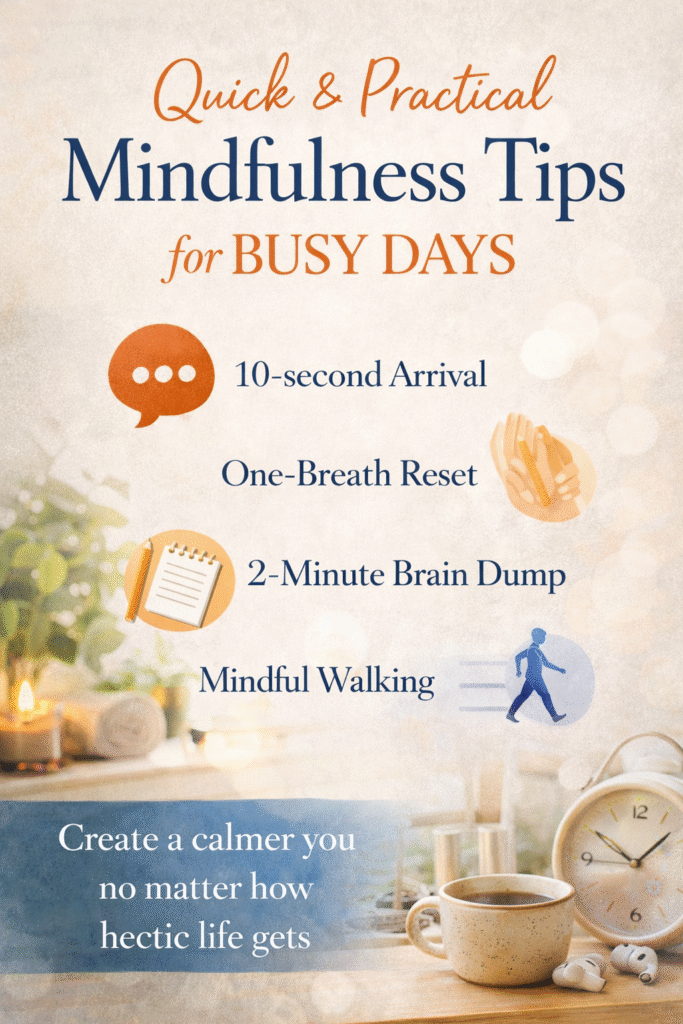
1) The 10-Second Arrival (Anytime You Switch Tasks)
You know that rushed feeling when you jump from one thing to the next and your brain never really lands? This helps.
How to do it:
- Pause before the next task.
- Say (in your head): “Arriving.”
- Notice three things:
- one sound you hear
- one sensation in your body
- one thing you see
That’s it. Ten seconds.
This trains your brain to enter moments rather than crash through them.
Use it for: opening your laptop, starting the car, stepping into work, beginning dinner, walking into a meeting.
2) The “Unclench Check” (The Body Leads the Mind)
Stress often lives in the same places: jaw, shoulders, hands, and stomach.
Set a simple mental cue you’ll remember—like every time you wash your hands or pick up your phone.
Do this quick scan:
- Unclench your jaw
- Drop your shoulders
- Relax your hands
- Exhale slowly
Even if your thoughts are racing, your body can soften first—and your mind will usually follow.
3) The One-Breath Reset (For Real-Life Interruptions)
This is the most realistic mindfulness technique you’ll ever learn.
How it works:
- Inhale through your nose
- Exhale longer than you inhaled (just slightly)
- While exhaling, think: “I’m here.”
One breath. That’s all.
Do it before:
- replying to a text you’re annoyed about
- walking back into the room with your kids after a long day
- clicking “send” on something important
- responding to a coworker when you feel defensive
You’re giving your nervous system a moment to choose wisdom instead of speed.
4) The 5-4-3-2-1 Grounding (When You Feel Overwhelmed)
This one is perfect when your thoughts feel scattered, or you’re running on adrenaline.
Name:
- 5 things you can see
- 4 things you can feel
- 3 things you can hear
- 2 things you can smell
- 1 thing you can taste (or one thing you’re grateful for)
You can do it quietly anywhere. It pulls you out of your head and into your senses, which is where calm starts.
5) The “Single-Task Minute” (Because Multitasking Is a Stress Trap)
Even if you can’t single-task all day, you can single-task for one minute.
Pick something you already do:
- drinking water
- making coffee
- walking to the bathroom
- wiping the counter
- loading the dishwasher
For one minute, do it with full attention:
- notice the temperature, sound, movement
- feel your feet
- breathe normally
- keep your mind with your hands
You’re teaching your brain that it doesn’t have to live in chaos.
6) Mindful Walking (No Special Outfit Required)
If you walk from one room to another, you have an opportunity for mindfulness.
Try this:
- Feel your feet make contact with the floor
- Let your arms swing naturally
- Relax your face (seriously—your face holds stress too)
- Match your steps to your breath for 5–10 steps
This works beautifully when you feel “wired” and need a physical reset.
7) The “Name It to Tame It” Technique (For Emotional Spikes)
When emotions flare, your nervous system goes into protection mode.
A simple label can reduce intensity.
In the moment, name what’s happening:
- “This is stress.”
- “This is anxiety.”
- “This is frustration.”
- “This is me feeling pressured.”
No drama. No judgment. Just naming.
Then add one gentle truth:
- “I can handle the next step.”
- “I don’t need to solve everything right now.”
- “I can slow down without falling behind.”
This technique is quick, private, and powerful.
8) The Two-Minute “Messy Mind” Dump (When Your Brain Won’t Shut Off)
Sometimes you’re not calm because your brain is holding too much (this is me)
This is a fast way to unload.
Set a timer for 2 minutes.
Write every thought down—messy, unfiltered, bullet points, whatever.
Then draw two quick columns:
- Can control today
- Can’t control today
Pick one item from “Can control today” and choose a next step that takes 5 minutes or less.
You’re not trying to fix your life. You’re clearing the mental clutter so you can breathe.
9) Micro-Mindfulness for Parents (Because Quiet Isn’t Always Possible)
If you have kids, mindfulness can feel like a joke some days. So, let’s make it real.
Try these:
- Mindful hugs: one full breath while hugging your child (feel their warmth, their little body, the moment)
- Mindful listening: when they talk, look at their face without doing anything else
- Mindful reset in the bathroom: a 20-second exhale with your shoulders down before you walk back out
Not perfect. Just present.
10) The “Stop the Rush” Reframe (When You’re Moving Too Fast)
Sometimes we rush even when we don’t need to. We’re used to urgency.
When you catch yourself speeding up—walking fast, talking fast, doing everything tight—try this phrase:
“I can move slowly and still get it done.”
Then, physically slow one thing down:
- how you close a drawer
- how you walk to the next room
- how you sip your drink
- how you type
It sounds almost too simple, but it signals safety to your nervous system.
How to Make Mindfulness Stick on Busy Days
The trick isn’t motivation. It’s anchors.
Pick 2–3 daily anchors—things you already do—and attach a technique to them.
Example anchors:
- After you start your car → one-breath reset
- When you wash your hands → unclench check
- Before you open your laptop → 10-second arrival
- When you drink water → single-task minute
When mindfulness becomes part of your routine, it stops feeling like “one more thing.”
A Sample “Busy Day Mindfulness Plan” (Realistic Edition)
Morning (30 seconds):
One-breath reset before you check your phone.
Midday (1 minute):
Unclench check + long exhale.
Afternoon (2 minutes):
5-4-3-2-1 grounding if you feel overstimulated.
Evening (1 minute):
Single-task for a minute while making dinner or washing up.
That’s 4–5 minutes total across the whole day—and it makes a difference.
Helpful Resources
- If you want a simple way to build a mindfulness habit, try a guided app session: YouTube
- Prefer something printable? A mindfulness journal or prompt deck can help you stay consistent: Amazon
- If you’re trying to build a calmer routine that actually fits your life, you’ll love my post on Self-Love and Mental Health—it breaks down simple ways to support your mind when your days feel heavy.
Final Thoughts
Busy days aren’t going anywhere. But you don’t have to disappear inside them.
Mindfulness is how you return to yourself—one breath, one unclenched jaw, one tiny pause at a time. And the more you practice it in small moments, the more available you’ll feel in the moments that actually matter.
Here’s to gentle growth, bold dreams, and a soul full of light.
~Kay~